Well, the yearly convention again returns, with a bevy of exciting one-shots. For convenience, I've listed all the non-fantasy, non-D&D games.
FRIDAY 7:00-11:00 PM
Shadow over Obama (Call of Cthulhu)
By Ken Kersey. Some say the stars are nearly right for a change. The date the Mayans predicted for the end of the world is just days away (December 21, 2012) and the planet is in the grip of a crawling chaos - economic collapse, global pandemics, disasters, supernatural events, dogs & cats living together, mass hysteria!! Find out what happens when you mix ancient prophesies, political puppets serving a cosmic evil (possibly cyclopean or even squamous), and a discovered birth certificate. Can you and your fellow Investigators stop the "Change" or will the Earth succumb to an unspeakable apocalypse. A sanity blasting adventure designed for 5 to 10 players (experience much preferred but not required), pre-generated characters will be provided. NO PREREGISTRATION!
If this is being done by the same guy that did the mystery about Al Gore a few years back, then I'll want to check this out, if only to see what kind of actual madness may exist amongst the people who want to play this scenario for all the wrong reasons.
SATURDAY 2:00-6:00 PM
Savage Worlds: The REALLY Bad Day (RPG)
It was just another boring day at the office, made even more trite by another boring office party. Then something went very, VERY wrong, and whatever else this day may become, it certainly isn't boring.
We're all pretty cool with Savage Worlds. Defenitely Something to look into, since I'm getting a "Full Life Consequences" vibe.
7:00-11:00 PM
Call of Cthulhu Newbie Session (Call of Cthulhu)
Come learn to play the classic horror roleplaying game, Call of Cthulhu! Your friendly Keepers will walk you through creating a character, then you'll have the chance to play a short scenario. Register at the con.
Neat, we could actually play a fun horror game of CoC without dealing with people who think Obama's the Anti-Chr- I mean, strong political opinions.
Paranoia (RPG)
Ever play an RPG and said man I wish I could just kill the PC next to me? Well here is your chance come join the fear called paranoia XP. You are a clone a world of color and the Computer is your friend. DO what it tells you and you will live unless it wants you dead. Paranoia is a six die game where you play a clone in the future. You live and breath for the Computer who is well Insane.
I'll say it: I have never had as much fun with any RPG as I had playing a convention game of Paranoia. We'll play this, whether anyone likes it or not.
Vampire the Requiem LARP (LARP)
All across Utah, the call has gone out from a vampire in Park City--the call is for peace. All across the state, violence against mortal and vampire alike has been on the rise, and the source of this violence appears to have been perpetrated the vampire court of Salt Lake City, Utah. Thus the court of Salt Lake City as well as all Utahn vampires have been invited to a summit to discuss the possibility of peace between vampires (if such a thing can exist) as well as to set misunderstandings straight. Will this event bring peace to the Valley and the neighboring cities or will it only promote hostilities? From whom did this call originate and is his or her intentions honorable? And what is the cause of all the recent violence all across the state? These questions may be answered by attendance but chances are they will actually become far more complicated.
It's always fun to watch goths method act from the sideline. In another thought, wouldn't Utah kinda be the best place to hide if you're undead?
Thursday, May 20, 2010

Tuesday, May 18, 2010
D&D 4th Edition: Why it isn't for me
I remember posting a video up on Youtube when I was young(er) and naive(er) about why 4E D&D was a pretty good role-playing game that remained (kind of) faithful to classic D&D.
My opinion has changed and, looking back, I was completely talking out of my ass.
Don't get me wrong, It's still a pretty good role-playing game, and the books themselves look absolutely great, but the game itself isn't in my style. Of course, I'm not talking about this in terms of changes from the various classic edition's rules (there never were any) or spirit (there might have been groups that played it as a series of miniature battles above all else).
Why don't I like it? Let me count the ways.
#1. Dungeons and Dragons: The Game of Fantasy Battles
4E retains the goal of accumulating power via looting ruins and stabbing orcs in the gut, which is cool. However, it takes this to the extreme. Everything is balanced around combat. I can't remember what page in the DMG this is on (someone out there help me out), but it says that a 4 hour session will likely consist of 4 fights around 20 to 30 minutes long. That's way to long to keep the attention of me or my players. All the character classes abilities are balanced around them spending half an hour using their Hadokens and Tiger Uppercut powers grinding down hit points (God help you if you try anything else). Half the excitement of classic D&D to me is exploration into the unknown, wondering what lies beyond the dungeon at the edge of town, into a vast wilderness.
In 4th edition, the time spent between a fight feels like a rush to get to the next exciting scene in a narrative linear story crafted by the game master (more on that later). Add to the fact that you are pretty much required to have a grid with miniatures since spacing and flanking is more important than ever. I know a fun activity where I spend a few hours having two teams fighting, with an emphasis on tactics and strategy, getting to watch my warriors improve from battle to battle: Skirmish wargaming. I recommend Necromunda, Gorkamorka, and Mordheim(a).
#2. Every Little Thing in its Place
The rules seem neurotic about balance (looking at magic-users in 3.x, I really don't blame them). It feels like a lot of the risk that was inherent in older editions is gone, as if a potential player who had his character die in a freak critical hit will tear up their character sheet and never play again, forever cursing the name of Dungeons & Dragons, warning any prospective new-comers...
To ensure no loss of a prospective customer base, every character is an unique and beautiful snowflake from day one of their career. This is fine by itself, allowing everyone a chance to shine on and off the battlefield. Too bad this also applied to everything else. Your adventure must have exactly 10 encounters (fights or skill challenges), give out these treasure parcels, and have this matrix of difficulty that we have set for it as a whole. What if a new player has his character come into the middle of the adventure? Maybe I'd like to put in this neat house rule? Uh-oh, then the balance of the whole thing is ruined, and all the little systems collapse in on themselves!
But don't worry, the characters will survive regardless, take this precise amount of damage, survive X amount of fights, and then rest on the 7th day. Of course, as long as they were maxed out at character creation and they're always doing the optimal action on their turn, or else...
The above probably is hyperbole, but it illustrates a point about 4th Edition. Everything must be done the way the book asks you to, and does it to the point where the game as a whole in incredibly un-modular in design. Balance and guidelines can be a comforting blanket for people like me because they ensure that as a DM, I can't possibly screw up. But eventually they act like a straight jacket denying creativity and neat ideas from outside the system. 4E has become self-aware, and now practically runs itself. When the risk and danger that random elements provide are taken away, so is the excitement of the players possibly failing, and the game ceases to be entertaining. And isn't entertainment the reason why we play these games?
#3. It May Be Built on a Gimmick
I'm sure every critic of the game has compared the class "powers" system to another game, that one game, a computer game itself inspired by D&D. I'll be tactful and not state its name. Regardless, it's probably responsible for a number of people leaving the role-playing hobby, the rest remaining as the players who continue to play games like D&D for all the right reasons. This is probably a dumb theory, but might the power systems alongside narrative linear adventure design be a way to get people back into playing these games they abandoned? but here lies a problem: If I wanted to play that one game, I'd just play it. Why bother with an expensive and confusing knock-off in book form? That one game can do the math for me. That one game was written by professional writers and storytellers. That one game has tangible graphics and can take me on an epic quest across a fantasy world with sixty character levels of play.
Interactivity and the act of collaborative storytelling is one of the few things that traditional role-playing games have left over their digital counterparts. The more we attempt to compete with that one game, the more outdated we look.
Traditional RPGs aren't inferior, they're just something completely different, and I can't wait for something like the holodeck to finally replace them.
This whole article probably comes off as a bit Grognard.txt, because it kinda is. I might harsh feelings for 4E, but not of the people who enjoy it. Claiming whether they must like it or not isn't my position, and it never should be.
My opinion has changed and, looking back, I was completely talking out of my ass.
Don't get me wrong, It's still a pretty good role-playing game, and the books themselves look absolutely great, but the game itself isn't in my style. Of course, I'm not talking about this in terms of changes from the various classic edition's rules (there never were any) or spirit (there might have been groups that played it as a series of miniature battles above all else).
Why don't I like it? Let me count the ways.
#1. Dungeons and Dragons: The Game of Fantasy Battles
4E retains the goal of accumulating power via looting ruins and stabbing orcs in the gut, which is cool. However, it takes this to the extreme. Everything is balanced around combat. I can't remember what page in the DMG this is on (someone out there help me out), but it says that a 4 hour session will likely consist of 4 fights around 20 to 30 minutes long. That's way to long to keep the attention of me or my players. All the character classes abilities are balanced around them spending half an hour using their Hadokens and Tiger Uppercut powers grinding down hit points (God help you if you try anything else). Half the excitement of classic D&D to me is exploration into the unknown, wondering what lies beyond the dungeon at the edge of town, into a vast wilderness.
In 4th edition, the time spent between a fight feels like a rush to get to the next exciting scene in a narrative linear story crafted by the game master (more on that later). Add to the fact that you are pretty much required to have a grid with miniatures since spacing and flanking is more important than ever. I know a fun activity where I spend a few hours having two teams fighting, with an emphasis on tactics and strategy, getting to watch my warriors improve from battle to battle: Skirmish wargaming. I recommend Necromunda, Gorkamorka, and Mordheim(a).
#2. Every Little Thing in its Place
The rules seem neurotic about balance (looking at magic-users in 3.x, I really don't blame them). It feels like a lot of the risk that was inherent in older editions is gone, as if a potential player who had his character die in a freak critical hit will tear up their character sheet and never play again, forever cursing the name of Dungeons & Dragons, warning any prospective new-comers...
To ensure no loss of a prospective customer base, every character is an unique and beautiful snowflake from day one of their career. This is fine by itself, allowing everyone a chance to shine on and off the battlefield. Too bad this also applied to everything else. Your adventure must have exactly 10 encounters (fights or skill challenges), give out these treasure parcels, and have this matrix of difficulty that we have set for it as a whole. What if a new player has his character come into the middle of the adventure? Maybe I'd like to put in this neat house rule? Uh-oh, then the balance of the whole thing is ruined, and all the little systems collapse in on themselves!
But don't worry, the characters will survive regardless, take this precise amount of damage, survive X amount of fights, and then rest on the 7th day. Of course, as long as they were maxed out at character creation and they're always doing the optimal action on their turn, or else...
The above probably is hyperbole, but it illustrates a point about 4th Edition. Everything must be done the way the book asks you to, and does it to the point where the game as a whole in incredibly un-modular in design. Balance and guidelines can be a comforting blanket for people like me because they ensure that as a DM, I can't possibly screw up. But eventually they act like a straight jacket denying creativity and neat ideas from outside the system. 4E has become self-aware, and now practically runs itself. When the risk and danger that random elements provide are taken away, so is the excitement of the players possibly failing, and the game ceases to be entertaining. And isn't entertainment the reason why we play these games?
#3. It May Be Built on a Gimmick
I'm sure every critic of the game has compared the class "powers" system to another game, that one game, a computer game itself inspired by D&D. I'll be tactful and not state its name. Regardless, it's probably responsible for a number of people leaving the role-playing hobby, the rest remaining as the players who continue to play games like D&D for all the right reasons. This is probably a dumb theory, but might the power systems alongside narrative linear adventure design be a way to get people back into playing these games they abandoned? but here lies a problem: If I wanted to play that one game, I'd just play it. Why bother with an expensive and confusing knock-off in book form? That one game can do the math for me. That one game was written by professional writers and storytellers. That one game has tangible graphics and can take me on an epic quest across a fantasy world with sixty character levels of play.
Interactivity and the act of collaborative storytelling is one of the few things that traditional role-playing games have left over their digital counterparts. The more we attempt to compete with that one game, the more outdated we look.
Traditional RPGs aren't inferior, they're just something completely different, and I can't wait for something like the holodeck to finally replace them.
This whole article probably comes off as a bit Grognard.txt, because it kinda is. I might harsh feelings for 4E, but not of the people who enjoy it. Claiming whether they must like it or not isn't my position, and it never should be.
Saturday, May 15, 2010
The meaning of rules and an interesting article
"The secret we should never let the gamemasters know is that they don't need any rules."
Gary Gygax
Just a quick musing, but I always thought that OD&D was ridiculously hard on players because if Swords and Wizardry is a clone of the original game, that kind of stuff would be in the three brown books. Then I look through the actual OD&D rules, and I realize something: What rules?
The booklets have no real instructions on handing out experience points (it states a troll has 700 xp, leading to people to believe that it's 100 xp per hit die), nor the amount of treasure found per monster, let alone how xp from it is divvied up. Of the rules that really are there, they are quite obtuse in writing (an elf can choose whether to be a fighter of a magic-user at the beginning of each adventure. What constitutes an adventure? A session? When the referee says?) I would go so to say that Original D&D is almost impossible to play without a hefty amount of house ruling. In reality, Swords and Wizardry is just one of many interpretations of what said rules mean.
For so long I've played games that explicitly tell me what to do and how to play and how to reward players along with hundreds of pages worth of rules to cover miniscule events that might pop up. Going back in time to this savage age of "guidelines" and "interpretation" is scary and frustrating, yet oddly liberating. I can't actually argue that our group is "playing it wrong", if there isn't any text on how to play in the first place. It's up to us. Our game, our rules.
In related news, here's an excellent article on why I shouldn't bother with linear plot in RPGs:
http://www.escapistmagazine.com/articles/view/columns/checkfortraps/7540-Check-for-Traps-It-s-Not-Your-Story
Gary Gygax
Just a quick musing, but I always thought that OD&D was ridiculously hard on players because if Swords and Wizardry is a clone of the original game, that kind of stuff would be in the three brown books. Then I look through the actual OD&D rules, and I realize something: What rules?
The booklets have no real instructions on handing out experience points (it states a troll has 700 xp, leading to people to believe that it's 100 xp per hit die), nor the amount of treasure found per monster, let alone how xp from it is divvied up. Of the rules that really are there, they are quite obtuse in writing (an elf can choose whether to be a fighter of a magic-user at the beginning of each adventure. What constitutes an adventure? A session? When the referee says?) I would go so to say that Original D&D is almost impossible to play without a hefty amount of house ruling. In reality, Swords and Wizardry is just one of many interpretations of what said rules mean.
For so long I've played games that explicitly tell me what to do and how to play and how to reward players along with hundreds of pages worth of rules to cover miniscule events that might pop up. Going back in time to this savage age of "guidelines" and "interpretation" is scary and frustrating, yet oddly liberating. I can't actually argue that our group is "playing it wrong", if there isn't any text on how to play in the first place. It's up to us. Our game, our rules.
In related news, here's an excellent article on why I shouldn't bother with linear plot in RPGs:
http://www.escapistmagazine.com/articles/view/columns/checkfortraps/7540-Check-for-Traps-It-s-Not-Your-Story
Thursday, May 6, 2010
Weww Hewwo evewyboy!

BROWNIES

Brownies are tiny, stunted, naive fairy-folk who live in close-knit communes. Despite their origins, they posses little magic power, and seem to be nothing more than a cruel joke by some capricious, long-dead fey god. 1-1/2’ tall and not too smart, Brownies lie below even kobolds in a dungeon food chain, and survive as a species through an incredibly large reproduction rate. Though a single-sex species, they all appear to be male, with excess facial growth, stylized, curled mustaches being the most common.
Armor Class: 8
Hit Dice: 1d2 hp
Attacks: Weapon, usually a sharpened stick (1d2)
Saving Throw: 19
Special: None
Move: 10
XP: 25
Sunday, May 2, 2010
A Survival Guide to OD&D

With the group descending into role-playing's original game, there was a bit of rejoicing. compact and rules-light OD&D is surprisingly simple compared to the 600 page Goliath that is the modern edition's combined core rules. However, there have been accusations that OD&D is "Ninendo hard", ludicrously lethal and deadly. Well, it can be, and, as referee, this is partially my fault for treating adventure design with monsters, encounters, and forms of advancement in the same way as I would 4th edition. So, here is a guide to making sure your character has a long, successful career in spelunking through strange labyrinths.
#1. You are not a high-fantasy hero.
In comparison to 4th edition, the starting character is a barely trained peasant with a lot of money to spend on protection. You are not the police officer making the arrest on COPS, you are the cameraman with some bulletproof armor for insurance. Keep that in mind when going to into the depths of the earth. A quick comparison below:

A level 1 4E character

Your level 1 fighter
#2. Bring some friends in with you.
Would you send a single G.I. to explore a VC tunnel system? The same principle applies to OD&D. I found it insane how book 1 of the white box recommends up to 20 PCs per referee. Looking at the results of 2 Characters fighting a single orc, I now understand. Depending on your ruling of hirelings, they may not take up a share of XP or treasure found. Though the personal gain is lesser with more adventurers in the party, your survivability goes up. It's a trade-off.
#3. Monsters are to be respected and feared.
The 3.5 DMG states that a suitable combat encounter with a party of four adventurers will result in them losing 1/5th of daily resources (HP, healing positions, spells). OD&D states through actual game play that the exact same scenario is guaranteed to result in the death of minimum of 1 party member (likely 2 or more if the monster gets lucky). Let's put this into another perspective: with armor, a 1 hit die monster is completely equal to an average level 1 fighting-man. Actually, he's better due to +1 to hit and a d8 hit die. One more example: The party's fighting man (the guy that's the best combatant in the team) has a 50% chance of death in total vs. a 1 HD monster, taking into account being hit. If the party takes on a single monster of their level, their taking a coin toss for the life of at least one of them. Furthermore, a monster is worth a measly 100 xp per hit die. The risk is NOT worth the reward. You need to avoid combat when possible, and always run away when the odds are not in your absolute favor.
"But then how do you level up without fighting monsters?"
Later editions of D&D had you level through combat, and the monsters are fairly balanced around this idea. loot is just an extra incentive, as the monsters will likely be guarding it. No, the key to power is detailed below.
#4. Go straight for the treasure.
Firstly, in classic D&D, 1 gold piece is worth 1 experience point. Secondly, 80% or more of your XP will come from found treasure . Thirdly, If you have a dungeon of 35 rooms stocked with treasure, 20 of them will likely be guarded, even then the monsters will probably moving around. At it's core, OD&D characters are treasure hunters, not exterminators. Adventuring parties are little more than glorified robbers and home invaders. You must seek out the hoards of loot while avoiding or sneaking past their owners. So far in the Forest Temple, the cleric was the only one left alive to escape, keeping 47 platinum pieces to himself, making him 33% closer to reaching 2nd level. Play like Wario, not Kratos.

He's got the right idea.
In conclusion, know your limits, put strength in numbers, avoid unnecessary violence, and go for the gold. Good luck down there. You'll need it.
Thursday, March 18, 2010
A Primer for old-school gaming
By Matthew J. Finch, the author of Swords and Wizardry
Quick Primer for Old School Gaming
This booklet is an introduction to “old school” gaming, designed especially for anyone who started playing fantasy role-playing games after, say, the year 2000 – but it’s also for longer-time players who have become adjusted to modern styles of role-playing over the years.
If you want to try a one-shot session of 0e using the free Swords & Wizardry rules, just printing the rules and starting to play as you normally do will produce a fairly pathetic gaming session – you’ll decide that 0e is just missing all kinds of important rules. You will have played a game where no situations had any sort of guidance, and you just imported rules from your normal game to fill in the gaps. This booklet is intended to fill the role of an experienced referee who’s actually played 0e – someone who can explain how the rules are put to use, not just what they are.
For the Players and the Referee:
Playing an old school game is very different from modern games where there are rules covering many specific situations. Read these rules as if they are the rules of a completely new role-playing game you’ve never seen before; keep in mind what you think is “missing” isn’t there on purpose; and remember that the GM has no obligation to be “fair,” just relatively impartial.
First Zen Moment: Rulings, not Rules
The biggest key to understanding “old school” gaming is like a Zen moment: much of the time, you don’t use a rule, you just use a ruling. It’s easy to understand that sentence, but it takes a flash of insight to really “get it.” I’m not saying that you’re going to have a flash of liking it. You might hate it. What I’m saying is that it’s a big intuitive leap from modern games to understand how this works. The players can describe any action, without needing to look at a character sheet to see if they “can” do it. The GM uses common sense or makes an ad-hoc ruling, and then the game moves on. This is why characters have so few numbers on the character sheet, and why they have so few specified abilities. Many of the things that are “die roll” challenges in modern gaming (disarming a trap, for example) are handled by observation, thinking, and experimentation in old-style games. Getting through obstacles is more “hands-on” than you’re probably used to.
A simple example: by tradition, many pit traps in 0e are treated as follows. They can be detected easily, by probing ahead with a 10ft pole. If you step onto one, there is a 1 in 6 chance that the pit trap will open. And that’s all there is to it. Thieves – if the game even uses thieves as a character class – don’t spot them unless specifically checking, and they don’t disarm.
Or say for instance you want your fighter to leap from a high ledge to the ground, both hands gripped tightly around the hilt of his sword to drive it deep into the back of the goblin below, who’s about to club the party’s cleric from behind. What do you do? You simply tell the referee what you want to do. Then the referee will probably ask you to roll to hit. If you hit, you do damage. You might even do extra damage because of your weight behind the blow. That will be for the DM to determine. If you are a ways off the ground you might have to check to see if you get hurt yourself – and maybe not, if you roll to hit well enough. On the other hand, the referee might decide that you automatically hit the goblin since you’re attacking from behind and from above, but not give you extra damage. However the referee decides the exact die rolls and numbers, it’s obvious that you’re going to have some sort of powerful attack here, even though you don’t have a specific “feat” or “skill” for this kind of maneuver written on your character sheet.
Second Zen Moment: Forget “Fair.”
A good GM is impartial, neither trying to favor the party nor the opposition. Beyond that, the party has no right to always encounter monsters they can defeat, no right to always encounter traps they can disarm, no right to invoke a particular rule from the books, and no right to a die roll in every particular circumstance. It is the GM’s game, and he calls the shots. It’s much less like a game of chess, and much more like a game of storytelling with dice. The only right the players have – and it’s a big one – the GM should never, ever, tell a player what the player’s character does. That’s the player’s decision. Unless the character is under a charm, or whatever, the player makes the decisions. With all the powers an old-style GM has, it is even more important not to “railroad” the game than it is in modern games.
Third Zen Moment: Heroic, not Superhero
Old School games have a human-sized scale, not a super-powered scale. At first level, adventurers are barely more capable than a regular person. They live by their wits. By the way, characters with low intelligence are still expected to be played intelligently as a matter of player skill. The player’s skill is the character’s guardian angel – call it the character’s luck or intuitions, or whatever makes sense to you, but you don’t cut back on your skill as a player just because the character has a low intelligence. It’s a game of skill. But back to the Zen moment. Even as characters rise to the heights of power, they aren’t picking up super-abilities or high ability scores. Truly high-level characters have precious items accumulated over a career of adventuring; they usually have some measure of political power, at least a stronghold. They are deadly when facing normal opponents … but they aren’t invincible. Old school gaming (and again, this is a matter of taste) is the fantasy of taking a guy without tremendous powers – a guy much like yourself but somewhat stronger, or with slight magic powers – and becoming a king or a feared sorcerer over time. It’s not about a guy who can, at the start of the game, take on ten club-wielding peasants at once. It’s got a real-world, gritty starting point. And your character isn’t personally ever going to become stronger than a dragon. At higher levels, he may be able to kill a dragon with his sword or with spells, but never by grabbing its throat and strangling it in a one-on-one test of strength. To make a comic-book analogy, characters don’t become Superman; they become Batman. And they don’t start as Batman – Batman is the pinnacle. He’s a bit faster than normal, a bit stronger than normal, he’s got a lot of cash, a Bat Cave, a butler, a henchman (Robin) and cool gadgets. But he can’t leap tall buildings in a single bound. If you don’t get a feeling of achievement with Batman instead of Superman as the goal, the old school gaming style probably isn’t right for your vision of what makes good and exciting fantasy. Old school gaming is about the triumph of the little guy into an epic hero, not the development of an epic hero into a superhuman being. There’s nothing wrong with the latter, it’s just that old-style fantasy matches up with the former.
Fourth Zen Moment: Game balance a minor factor
Game Balance is not the all-important measure of all things in old-style gaming. At any given time, one character may very well be more powerful than the rest (the experience tables cause some character classes to level up earlier than others). A few adventures later, the tables will turn as other characters level up – a different character often takes the limelight for a while.
This is a co-operative game played among friends, not a competition to have the most powerful character. The competition is against the fantasy world, not against the other players and not against the referee. Focusing heavily on “Game balance” is a method for highly exact, competitive games. It’s okay to be inexact and approximate with game balance, as long as the boat’s not in danger of completely capsizing.
For the Game Master
As the Game Master, you’ve got to wrap your head around those Zen moments – at least a little bit – before refereeing a game using the 0e rules, or Swords & Wizardry, or whatever game you’ve chosen to try out. You’re the most important factor in making sure the game is actually the old-style game you want to try out: if you don’t at least get a basic grasp of those four ideas then what you run will just be a modern-style game without enough rules.
Remember: You are the rulebook. There is no other rulebook.
Make it fast, make it colorful, and make it full of decisions for the players.
Resource management: It’s important to realize that old-style gaming is a game that involves a lot of “resource management.” Your party has a finite number of spells, a finite amount of food, a finite amount of torches, and a finite amount of damage that it can absorb. Light sources and food become less important at higher levels, but spells and hit points are always vital commodities that you’ve got to keep an eye upon. Some modern-style gamers don’t like this part of a role-playing game, thinking that it’s not adventurous to be worrying about how long the torches will burn, and that it’s silly for a magic-user to use one spell and then be “useless” for the rest of the adventure. Just take it on faith for a moment that this is an important and exciting part of old-style gaming. It’s one of those things that if it’s done right adds lots of tension and excitement. It might still not be your cup of tea – there are many different ways to enjoy fantasy gaming – but to really experience the “old-style” manner of play, this is pretty important. It comes back to that earlier Zen Moment about how old-style gaming is built on a human scale, not on a superhuman scale. Having to worry about things like whether the torches are going to run out emphasizes the experience of being a “regular person” exploring a very dark and very dangerous place where people really don’t belong. Gaining the ability to use magical light and to create food supplies is an achievement – an achievement too low to register on the modern-style, superhuman scale of things perhaps, but for a “regular guy” type of adventurer it’s a milestone.
So, here’s how you run a game where resource management is a significant factor. The challenge to the players is to get where they want to go (places with piles of gold, they hope) without having to retreat. There’s a cost to retreating: perhaps they can barely afford their upkeep at the local inn; perhaps their reward from the local baron is reduced if they can’t achieve the mission within a certain number of days; perhaps there’s a risk that a hostage will be killed; perhaps there’s another adventuring party that’s trying to reach the same treasure. In other words, there’s also got to be a race against time. It might not be a fast race, and it might not have an overwhelming sense of urgency to it, but there’s got to be a race against time. Otherwise, yes, managing resources isn’t particularly fun – it’s unnecessary bookkeeping. The combination of race against time against depleting resources is a very powerful source of drama and tension. It’s one of the driving forces of old-style gaming. At low level, the race against time is often just to have enough money to scrape by: as the GM, you set some amount of money that they’re spending per day or per week. If they want to scrimp and save let them, but constantly describe the rats in their foul lodgings, the bland porridge they’re eating, the condescending attitude of villagers who see the characters failing to succeed – they’ll speed up their efforts. At higher levels, creating the race against time requires a bit more creativity on your part – especially because you don’t want to make it into something that forces the players into any particular adventure. The players should always have control over what their characters can do, so you’ve got to avoid overusing the whole “the king will have you executed if you don’t rescue the princess” sort of adventure hook.
Combat is abstract. One criticism that’s often leveled against old-style gaming is that it’s boring to just have a series of: “I roll a d20. Miss. I roll a d20. Hit. I roll a d20. Miss. I roll a d20. Miss.” It’s true that from time to time the “tape” of an old-style combat is exactly like this. Some combats are unimportant enough that no one bothers to try anything particularly unusual, and if there’s not a fumble or a critical hit, and the party doesn’t get into hot water then this kind of combat won’t use much tactical thinking on anyone’s part. So why even have it? Because every quick, less-significant combat uses up resources. And when I say quick, I mean very, very quick. In modern games, where combat contains special moves and lots of rules, combat takes up lots of time. An “insignificant” combat is a complete waste of gaming time. In older rules, a small combat can take five minutes or less. So small combats work very well as a way of depleting those precious resources in a race against time. The players will actually seek to avoid minor combats when there’s not much treasure involved. They’re looking for the lairs and the treasure troves, not seeking to kill everything that crosses their path. The classic old-style adventure contains “wandering monsters” that can randomly run into and attack the party, and some modern gamers see this as arbitrary. It’s not. It’s another instance of running a race against time – if the characters aren’t smart and fast in getting to the lairs and troves, if they shilly-shally and wander, they’re going to lose hit points and spells fighting wandering monsters who carry virtually no treasure. This is also, by the way, why older-style games award experience points for gaining treasure as well as for killing monsters. If killing monsters is the only way to gain experience points, then one monster’s pretty much the same as another – the players don’t have much of an incentive to avoid combat. When treasure is the best source of experience points and there’s a race against time, the players have every incentive to use all their skill and creativity to avoid encounters that drain their resources. They’ve got to press on to the mission before they become too weak to keep going.
So that’s why combat is abstract, or at least it’s one reason. Also, of course, fast combat mimics the pace of combat – in more complex games, players may have to sit for a while, contemplating the next “move” like a chess game. I’ve heard of egg timers being used to limit thinking time. With old-style, abstract combat, this just doesn’t happen (not often, anyway). Abstract combat also opens the door for one of the things that’s most important about old-style gaming – the freewheeling feel of “anything goes.”
In old-style combat, a player can describe and attempt virtually anything he can think of. He doesn’t need to have any sort of game-defined ability to do it. He can try to slide on the ground between opponents, swing from a chandelier and chop at a distant foe, taunt an opponent into running over a pit trap … whatever he wants to try. That doesn’t, of course, mean that he’ll succeed. It’s your job to handle these attempts colorfully and fairly, choosing whatever probability you think is the right one and rolling some dice. Sometimes you’ll enforce common sense and roll that one in 10,000 chance. When the players truly understand that their characters’ actions aren’t constrained by the lack of a specific ability, you’ll find that combat becomes quite interesting. It’s also your job to inject events that wouldn’t occur within the format of a specific set of rules for what happens during combat. “You rolled a 1. Your sword goes flying.” “You rolled a 1. You trip and fall.” “You rolled a 1. Your sword sticks into a crack in the floor.” “Hey, you rolled a 20. You spin around and gain an extra attack.” Hey, you rolled a 20. You slay the orc, kick his body off your sword, and blood spatters into the eyes of one of the orcs behind him.” “Hey, you rolled a 20. You knock his sword out of his hand even though he’s not killed.” That’s just a set of examples for the various ways you could handle natural rolls of 1 or 20 without the constraint of specific rules. Even when the rolls aren’t unusual, you keep up a running picture of what’s happening. Not all the time – the players have their own mental picture of what’s happening, and you don’t want to step on their imaginations. But you’re also able to have monsters doing unexpected things – throwing a bench in the attempt to knock down two characters at once, monsters that try to swing by chandeliers, and other such challenges that don’t often surface in games with tighter rules. Try to put some “toys” into the combat areas some of the time: benches, places where you can fight from the high ground, slippery patches, etc. Because of the speed of the abstract combat system, unusual tricks by the players and monsters don’t cause delays while the rules are consulted. It’s all you – you are the rulebook.
Quick Primer for Old School Gaming
This booklet is an introduction to “old school” gaming, designed especially for anyone who started playing fantasy role-playing games after, say, the year 2000 – but it’s also for longer-time players who have become adjusted to modern styles of role-playing over the years.
If you want to try a one-shot session of 0e using the free Swords & Wizardry rules, just printing the rules and starting to play as you normally do will produce a fairly pathetic gaming session – you’ll decide that 0e is just missing all kinds of important rules. You will have played a game where no situations had any sort of guidance, and you just imported rules from your normal game to fill in the gaps. This booklet is intended to fill the role of an experienced referee who’s actually played 0e – someone who can explain how the rules are put to use, not just what they are.
For the Players and the Referee:
Playing an old school game is very different from modern games where there are rules covering many specific situations. Read these rules as if they are the rules of a completely new role-playing game you’ve never seen before; keep in mind what you think is “missing” isn’t there on purpose; and remember that the GM has no obligation to be “fair,” just relatively impartial.
First Zen Moment: Rulings, not Rules
The biggest key to understanding “old school” gaming is like a Zen moment: much of the time, you don’t use a rule, you just use a ruling. It’s easy to understand that sentence, but it takes a flash of insight to really “get it.” I’m not saying that you’re going to have a flash of liking it. You might hate it. What I’m saying is that it’s a big intuitive leap from modern games to understand how this works. The players can describe any action, without needing to look at a character sheet to see if they “can” do it. The GM uses common sense or makes an ad-hoc ruling, and then the game moves on. This is why characters have so few numbers on the character sheet, and why they have so few specified abilities. Many of the things that are “die roll” challenges in modern gaming (disarming a trap, for example) are handled by observation, thinking, and experimentation in old-style games. Getting through obstacles is more “hands-on” than you’re probably used to.
A simple example: by tradition, many pit traps in 0e are treated as follows. They can be detected easily, by probing ahead with a 10ft pole. If you step onto one, there is a 1 in 6 chance that the pit trap will open. And that’s all there is to it. Thieves – if the game even uses thieves as a character class – don’t spot them unless specifically checking, and they don’t disarm.
Or say for instance you want your fighter to leap from a high ledge to the ground, both hands gripped tightly around the hilt of his sword to drive it deep into the back of the goblin below, who’s about to club the party’s cleric from behind. What do you do? You simply tell the referee what you want to do. Then the referee will probably ask you to roll to hit. If you hit, you do damage. You might even do extra damage because of your weight behind the blow. That will be for the DM to determine. If you are a ways off the ground you might have to check to see if you get hurt yourself – and maybe not, if you roll to hit well enough. On the other hand, the referee might decide that you automatically hit the goblin since you’re attacking from behind and from above, but not give you extra damage. However the referee decides the exact die rolls and numbers, it’s obvious that you’re going to have some sort of powerful attack here, even though you don’t have a specific “feat” or “skill” for this kind of maneuver written on your character sheet.
Second Zen Moment: Forget “Fair.”
A good GM is impartial, neither trying to favor the party nor the opposition. Beyond that, the party has no right to always encounter monsters they can defeat, no right to always encounter traps they can disarm, no right to invoke a particular rule from the books, and no right to a die roll in every particular circumstance. It is the GM’s game, and he calls the shots. It’s much less like a game of chess, and much more like a game of storytelling with dice. The only right the players have – and it’s a big one – the GM should never, ever, tell a player what the player’s character does. That’s the player’s decision. Unless the character is under a charm, or whatever, the player makes the decisions. With all the powers an old-style GM has, it is even more important not to “railroad” the game than it is in modern games.
Third Zen Moment: Heroic, not Superhero
Old School games have a human-sized scale, not a super-powered scale. At first level, adventurers are barely more capable than a regular person. They live by their wits. By the way, characters with low intelligence are still expected to be played intelligently as a matter of player skill. The player’s skill is the character’s guardian angel – call it the character’s luck or intuitions, or whatever makes sense to you, but you don’t cut back on your skill as a player just because the character has a low intelligence. It’s a game of skill. But back to the Zen moment. Even as characters rise to the heights of power, they aren’t picking up super-abilities or high ability scores. Truly high-level characters have precious items accumulated over a career of adventuring; they usually have some measure of political power, at least a stronghold. They are deadly when facing normal opponents … but they aren’t invincible. Old school gaming (and again, this is a matter of taste) is the fantasy of taking a guy without tremendous powers – a guy much like yourself but somewhat stronger, or with slight magic powers – and becoming a king or a feared sorcerer over time. It’s not about a guy who can, at the start of the game, take on ten club-wielding peasants at once. It’s got a real-world, gritty starting point. And your character isn’t personally ever going to become stronger than a dragon. At higher levels, he may be able to kill a dragon with his sword or with spells, but never by grabbing its throat and strangling it in a one-on-one test of strength. To make a comic-book analogy, characters don’t become Superman; they become Batman. And they don’t start as Batman – Batman is the pinnacle. He’s a bit faster than normal, a bit stronger than normal, he’s got a lot of cash, a Bat Cave, a butler, a henchman (Robin) and cool gadgets. But he can’t leap tall buildings in a single bound. If you don’t get a feeling of achievement with Batman instead of Superman as the goal, the old school gaming style probably isn’t right for your vision of what makes good and exciting fantasy. Old school gaming is about the triumph of the little guy into an epic hero, not the development of an epic hero into a superhuman being. There’s nothing wrong with the latter, it’s just that old-style fantasy matches up with the former.
Fourth Zen Moment: Game balance a minor factor
Game Balance is not the all-important measure of all things in old-style gaming. At any given time, one character may very well be more powerful than the rest (the experience tables cause some character classes to level up earlier than others). A few adventures later, the tables will turn as other characters level up – a different character often takes the limelight for a while.
This is a co-operative game played among friends, not a competition to have the most powerful character. The competition is against the fantasy world, not against the other players and not against the referee. Focusing heavily on “Game balance” is a method for highly exact, competitive games. It’s okay to be inexact and approximate with game balance, as long as the boat’s not in danger of completely capsizing.
For the Game Master
As the Game Master, you’ve got to wrap your head around those Zen moments – at least a little bit – before refereeing a game using the 0e rules, or Swords & Wizardry, or whatever game you’ve chosen to try out. You’re the most important factor in making sure the game is actually the old-style game you want to try out: if you don’t at least get a basic grasp of those four ideas then what you run will just be a modern-style game without enough rules.
Remember: You are the rulebook. There is no other rulebook.
Make it fast, make it colorful, and make it full of decisions for the players.
Resource management: It’s important to realize that old-style gaming is a game that involves a lot of “resource management.” Your party has a finite number of spells, a finite amount of food, a finite amount of torches, and a finite amount of damage that it can absorb. Light sources and food become less important at higher levels, but spells and hit points are always vital commodities that you’ve got to keep an eye upon. Some modern-style gamers don’t like this part of a role-playing game, thinking that it’s not adventurous to be worrying about how long the torches will burn, and that it’s silly for a magic-user to use one spell and then be “useless” for the rest of the adventure. Just take it on faith for a moment that this is an important and exciting part of old-style gaming. It’s one of those things that if it’s done right adds lots of tension and excitement. It might still not be your cup of tea – there are many different ways to enjoy fantasy gaming – but to really experience the “old-style” manner of play, this is pretty important. It comes back to that earlier Zen Moment about how old-style gaming is built on a human scale, not on a superhuman scale. Having to worry about things like whether the torches are going to run out emphasizes the experience of being a “regular person” exploring a very dark and very dangerous place where people really don’t belong. Gaining the ability to use magical light and to create food supplies is an achievement – an achievement too low to register on the modern-style, superhuman scale of things perhaps, but for a “regular guy” type of adventurer it’s a milestone.
So, here’s how you run a game where resource management is a significant factor. The challenge to the players is to get where they want to go (places with piles of gold, they hope) without having to retreat. There’s a cost to retreating: perhaps they can barely afford their upkeep at the local inn; perhaps their reward from the local baron is reduced if they can’t achieve the mission within a certain number of days; perhaps there’s a risk that a hostage will be killed; perhaps there’s another adventuring party that’s trying to reach the same treasure. In other words, there’s also got to be a race against time. It might not be a fast race, and it might not have an overwhelming sense of urgency to it, but there’s got to be a race against time. Otherwise, yes, managing resources isn’t particularly fun – it’s unnecessary bookkeeping. The combination of race against time against depleting resources is a very powerful source of drama and tension. It’s one of the driving forces of old-style gaming. At low level, the race against time is often just to have enough money to scrape by: as the GM, you set some amount of money that they’re spending per day or per week. If they want to scrimp and save let them, but constantly describe the rats in their foul lodgings, the bland porridge they’re eating, the condescending attitude of villagers who see the characters failing to succeed – they’ll speed up their efforts. At higher levels, creating the race against time requires a bit more creativity on your part – especially because you don’t want to make it into something that forces the players into any particular adventure. The players should always have control over what their characters can do, so you’ve got to avoid overusing the whole “the king will have you executed if you don’t rescue the princess” sort of adventure hook.
Combat is abstract. One criticism that’s often leveled against old-style gaming is that it’s boring to just have a series of: “I roll a d20. Miss. I roll a d20. Hit. I roll a d20. Miss. I roll a d20. Miss.” It’s true that from time to time the “tape” of an old-style combat is exactly like this. Some combats are unimportant enough that no one bothers to try anything particularly unusual, and if there’s not a fumble or a critical hit, and the party doesn’t get into hot water then this kind of combat won’t use much tactical thinking on anyone’s part. So why even have it? Because every quick, less-significant combat uses up resources. And when I say quick, I mean very, very quick. In modern games, where combat contains special moves and lots of rules, combat takes up lots of time. An “insignificant” combat is a complete waste of gaming time. In older rules, a small combat can take five minutes or less. So small combats work very well as a way of depleting those precious resources in a race against time. The players will actually seek to avoid minor combats when there’s not much treasure involved. They’re looking for the lairs and the treasure troves, not seeking to kill everything that crosses their path. The classic old-style adventure contains “wandering monsters” that can randomly run into and attack the party, and some modern gamers see this as arbitrary. It’s not. It’s another instance of running a race against time – if the characters aren’t smart and fast in getting to the lairs and troves, if they shilly-shally and wander, they’re going to lose hit points and spells fighting wandering monsters who carry virtually no treasure. This is also, by the way, why older-style games award experience points for gaining treasure as well as for killing monsters. If killing monsters is the only way to gain experience points, then one monster’s pretty much the same as another – the players don’t have much of an incentive to avoid combat. When treasure is the best source of experience points and there’s a race against time, the players have every incentive to use all their skill and creativity to avoid encounters that drain their resources. They’ve got to press on to the mission before they become too weak to keep going.
So that’s why combat is abstract, or at least it’s one reason. Also, of course, fast combat mimics the pace of combat – in more complex games, players may have to sit for a while, contemplating the next “move” like a chess game. I’ve heard of egg timers being used to limit thinking time. With old-style, abstract combat, this just doesn’t happen (not often, anyway). Abstract combat also opens the door for one of the things that’s most important about old-style gaming – the freewheeling feel of “anything goes.”
In old-style combat, a player can describe and attempt virtually anything he can think of. He doesn’t need to have any sort of game-defined ability to do it. He can try to slide on the ground between opponents, swing from a chandelier and chop at a distant foe, taunt an opponent into running over a pit trap … whatever he wants to try. That doesn’t, of course, mean that he’ll succeed. It’s your job to handle these attempts colorfully and fairly, choosing whatever probability you think is the right one and rolling some dice. Sometimes you’ll enforce common sense and roll that one in 10,000 chance. When the players truly understand that their characters’ actions aren’t constrained by the lack of a specific ability, you’ll find that combat becomes quite interesting. It’s also your job to inject events that wouldn’t occur within the format of a specific set of rules for what happens during combat. “You rolled a 1. Your sword goes flying.” “You rolled a 1. You trip and fall.” “You rolled a 1. Your sword sticks into a crack in the floor.” “Hey, you rolled a 20. You spin around and gain an extra attack.” Hey, you rolled a 20. You slay the orc, kick his body off your sword, and blood spatters into the eyes of one of the orcs behind him.” “Hey, you rolled a 20. You knock his sword out of his hand even though he’s not killed.” That’s just a set of examples for the various ways you could handle natural rolls of 1 or 20 without the constraint of specific rules. Even when the rolls aren’t unusual, you keep up a running picture of what’s happening. Not all the time – the players have their own mental picture of what’s happening, and you don’t want to step on their imaginations. But you’re also able to have monsters doing unexpected things – throwing a bench in the attempt to knock down two characters at once, monsters that try to swing by chandeliers, and other such challenges that don’t often surface in games with tighter rules. Try to put some “toys” into the combat areas some of the time: benches, places where you can fight from the high ground, slippery patches, etc. Because of the speed of the abstract combat system, unusual tricks by the players and monsters don’t cause delays while the rules are consulted. It’s all you – you are the rulebook.
Sunday, March 7, 2010
Why I like "A Song of Blades and Heroes"
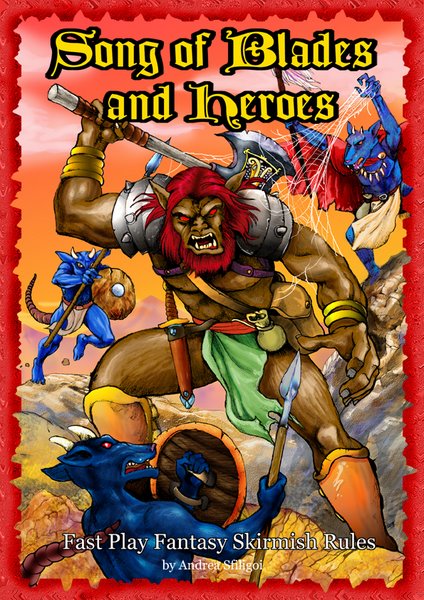
Hey Paisanos, Time to try and make a one article a week quota to build some tolerance for the craft. This time I explore the skirmish wargame A song of Blades and Heroes (SBH) by Ganesha Games. So what brings my attention to making this a front-burner project?
1. Rules-light, tactics deep
Weighing in at 35 pages and costing $4, SBH is relatively easy to learn, with 3 stats per model and a handful of exceptions based special rules. a standard 300 point game runs for about half an hour. The book even has rules of campaign games, allowing you to have a narrative driven "Mordheim" style series of 3 to 5 matches in an evening's time. Fast, Furious Fun.
2. Use whatever model you want
While the book is filled with pre-gen statlines for most generic fantasy creatures, there website also has a nice java points calculator for making units. You can use whatever models you have on you.
3. Light investment by miniature wargames standards
the standard warband is about 10-15 models, and even less if you're rocking an elite force. My planned undead warband will consist of 28mm models from Reaper minis will set me back about 50$, shipping and handling included. After that it's just a matter of painting and basing. It's even cheaper in 15mm (the scale the game was designed for, though it has conversion guidelines for 28's), with their being an official line from Splintered Light Minis.

A Lizard-folk warband made of old Lizardmen and D&D Kua-Toa
4. Groovy expansions, with more to come
The game now has expansion books for competetive dungeon crawls, wilderness scenarios, and grandiose hex-based territory campaigns. A plethora of options awaits!
Subscribe to:
Posts (Atom)