Sunday, May 2, 2010

A Survival Guide to OD&D


With the group descending into role-playing's original game, there was a bit of rejoicing. compact and rules-light OD&D is surprisingly simple compared to the 600 page Goliath that is the modern edition's combined core rules. However, there have been accusations that OD&D is "Ninendo hard", ludicrously lethal and deadly. Well, it can be, and, as referee, this is partially my fault for treating adventure design with monsters, encounters, and forms of advancement in the same way as I would 4th edition. So, here is a guide to making sure your character has a long, successful career in spelunking through strange labyrinths.

#1. You are not a high-fantasy hero.
In comparison to 4th edition, the starting character is a barely trained peasant with a lot of money to spend on protection. You are not the police officer making the arrest on COPS, you are the cameraman with some bulletproof armor for insurance. Keep that in mind when going to into the depths of the earth. A quick comparison below:


A level 1 4E character


Your level 1 fighter

#2. Bring some friends in with you.
Would you send a single G.I. to explore a VC tunnel system? The same principle applies to OD&D. I found it insane how book 1 of the white box recommends up to 20 PCs per referee. Looking at the results of 2 Characters fighting a single orc, I now understand. Depending on your ruling of hirelings, they may not take up a share of XP or treasure found. Though the personal gain is lesser with more adventurers in the party, your survivability goes up. It's a trade-off.

#3. Monsters are to be respected and feared.
The 3.5 DMG states that a suitable combat encounter with a party of four adventurers will result in them losing 1/5th of daily resources (HP, healing positions, spells). OD&D states through actual game play that the exact same scenario is guaranteed to result in the death of minimum of 1 party member (likely 2 or more if the monster gets lucky). Let's put this into another perspective: with armor, a 1 hit die monster is completely equal to an average level 1 fighting-man. Actually, he's better due to +1 to hit and a d8 hit die. One more example: The party's fighting man (the guy that's the best combatant in the team) has a 50% chance of death in total vs. a 1 HD monster, taking into account being hit. If the party takes on a single monster of their level, their taking a coin toss for the life of at least one of them. Furthermore, a monster is worth a measly 100 xp per hit die. The risk is NOT worth the reward. You need to avoid combat when possible, and always run away when the odds are not in your absolute favor.
"But then how do you level up without fighting monsters?"
Later editions of D&D had you level through combat, and the monsters are fairly balanced around this idea. loot is just an extra incentive, as the monsters will likely be guarding it. No, the key to power is detailed below.

#4. Go straight for the treasure.
Firstly, in classic D&D, 1 gold piece is worth 1 experience point. Secondly, 80% or more of your XP will come from found treasure . Thirdly, If you have a dungeon of 35 rooms stocked with treasure, 20 of them will likely be guarded, even then the monsters will probably moving around. At it's core, OD&D characters are treasure hunters, not exterminators. Adventuring parties are little more than glorified robbers and home invaders. You must seek out the hoards of loot while avoiding or sneaking past their owners. So far in the Forest Temple, the cleric was the only one left alive to escape, keeping 47 platinum pieces to himself, making him 33% closer to reaching 2nd level. Play like Wario, not Kratos.


He's got the right idea.

In conclusion, know your limits, put strength in numbers, avoid unnecessary violence, and go for the gold. Good luck down there. You'll need it.

Thursday, March 18, 2010

A Primer for old-school gaming

By Matthew J. Finch, the author of Swords and Wizardry

Quick Primer for Old School Gaming

This booklet is an introduction to “old school” gaming, designed especially for anyone who started playing fantasy role-playing games after, say, the year 2000 – but it’s also for longer-time players who have become adjusted to modern styles of role-playing over the years.

If you want to try a one-shot session of 0e using the free Swords & Wizardry rules, just printing the rules and starting to play as you normally do will produce a fairly pathetic gaming session – you’ll decide that 0e is just missing all kinds of important rules. You will have played a game where no situations had any sort of guidance, and you just imported rules from your normal game to fill in the gaps. This booklet is intended to fill the role of an experienced referee who’s actually played 0e – someone who can explain how the rules are put to use, not just what they are.

For the Players and the Referee:


Playing an old school game is very different from modern games where there are rules covering many specific situations. Read these rules as if they are the rules of a completely new role-playing game you’ve never seen before; keep in mind what you think is “missing” isn’t there on purpose; and remember that the GM has no obligation to be “fair,” just relatively impartial.

First Zen Moment: Rulings, not Rules
The biggest key to understanding “old school” gaming is like a Zen moment: much of the time, you don’t use a rule, you just use a ruling. It’s easy to understand that sentence, but it takes a flash of insight to really “get it.” I’m not saying that you’re going to have a flash of liking it. You might hate it. What I’m saying is that it’s a big intuitive leap from modern games to understand how this works. The players can describe any action, without needing to look at a character sheet to see if they “can” do it. The GM uses common sense or makes an ad-hoc ruling, and then the game moves on. This is why characters have so few numbers on the character sheet, and why they have so few specified abilities. Many of the things that are “die roll” challenges in modern gaming (disarming a trap, for example) are handled by observation, thinking, and experimentation in old-style games. Getting through obstacles is more “hands-on” than you’re probably used to.

A simple example: by tradition, many pit traps in 0e are treated as follows. They can be detected easily, by probing ahead with a 10ft pole. If you step onto one, there is a 1 in 6 chance that the pit trap will open. And that’s all there is to it. Thieves – if the game even uses thieves as a character class – don’t spot them unless specifically checking, and they don’t disarm.

Or say for instance you want your fighter to leap from a high ledge to the ground, both hands gripped tightly around the hilt of his sword to drive it deep into the back of the goblin below, who’s about to club the party’s cleric from behind. What do you do? You simply tell the referee what you want to do. Then the referee will probably ask you to roll to hit. If you hit, you do damage. You might even do extra damage because of your weight behind the blow. That will be for the DM to determine. If you are a ways off the ground you might have to check to see if you get hurt yourself – and maybe not, if you roll to hit well enough. On the other hand, the referee might decide that you automatically hit the goblin since you’re attacking from behind and from above, but not give you extra damage. However the referee decides the exact die rolls and numbers, it’s obvious that you’re going to have some sort of powerful attack here, even though you don’t have a specific “feat” or “skill” for this kind of maneuver written on your character sheet.

Second Zen Moment: Forget “Fair.”

A good GM is impartial, neither trying to favor the party nor the opposition. Beyond that, the party has no right to always encounter monsters they can defeat, no right to always encounter traps they can disarm, no right to invoke a particular rule from the books, and no right to a die roll in every particular circumstance. It is the GM’s game, and he calls the shots. It’s much less like a game of chess, and much more like a game of storytelling with dice. The only right the players have – and it’s a big one – the GM should never, ever, tell a player what the player’s character does. That’s the player’s decision. Unless the character is under a charm, or whatever, the player makes the decisions. With all the powers an old-style GM has, it is even more important not to “railroad” the game than it is in modern games.

Third Zen Moment: Heroic, not Superhero
Old School games have a human-sized scale, not a super-powered scale. At first level, adventurers are barely more capable than a regular person. They live by their wits. By the way, characters with low intelligence are still expected to be played intelligently as a matter of player skill. The player’s skill is the character’s guardian angel – call it the character’s luck or intuitions, or whatever makes sense to you, but you don’t cut back on your skill as a player just because the character has a low intelligence. It’s a game of skill. But back to the Zen moment. Even as characters rise to the heights of power, they aren’t picking up super-abilities or high ability scores. Truly high-level characters have precious items accumulated over a career of adventuring; they usually have some measure of political power, at least a stronghold. They are deadly when facing normal opponents … but they aren’t invincible. Old school gaming (and again, this is a matter of taste) is the fantasy of taking a guy without tremendous powers – a guy much like yourself but somewhat stronger, or with slight magic powers – and becoming a king or a feared sorcerer over time. It’s not about a guy who can, at the start of the game, take on ten club-wielding peasants at once. It’s got a real-world, gritty starting point. And your character isn’t personally ever going to become stronger than a dragon. At higher levels, he may be able to kill a dragon with his sword or with spells, but never by grabbing its throat and strangling it in a one-on-one test of strength. To make a comic-book analogy, characters don’t become Superman; they become Batman. And they don’t start as Batman – Batman is the pinnacle. He’s a bit faster than normal, a bit stronger than normal, he’s got a lot of cash, a Bat Cave, a butler, a henchman (Robin) and cool gadgets. But he can’t leap tall buildings in a single bound. If you don’t get a feeling of achievement with Batman instead of Superman as the goal, the old school gaming style probably isn’t right for your vision of what makes good and exciting fantasy. Old school gaming is about the triumph of the little guy into an epic hero, not the development of an epic hero into a superhuman being. There’s nothing wrong with the latter, it’s just that old-style fantasy matches up with the former.

Fourth Zen Moment: Game balance a minor factor

Game Balance is not the all-important measure of all things in old-style gaming. At any given time, one character may very well be more powerful than the rest (the experience tables cause some character classes to level up earlier than others). A few adventures later, the tables will turn as other characters level up – a different character often takes the limelight for a while.

This is a co-operative game played among friends, not a competition to have the most powerful character. The competition is against the fantasy world, not against the other players and not against the referee. Focusing heavily on “Game balance” is a method for highly exact, competitive games. It’s okay to be inexact and approximate with game balance, as long as the boat’s not in danger of completely capsizing.

For the Game Master

As the Game Master, you’ve got to wrap your head around those Zen moments – at least a little bit – before refereeing a game using the 0e rules, or Swords & Wizardry, or whatever game you’ve chosen to try out. You’re the most important factor in making sure the game is actually the old-style game you want to try out: if you don’t at least get a basic grasp of those four ideas then what you run will just be a modern-style game without enough rules.

Remember: You are the rulebook. There is no other rulebook.

Make it fast, make it colorful, and make it full of decisions for the players.

Resource management: It’s important to realize that old-style gaming is a game that involves a lot of “resource management.” Your party has a finite number of spells, a finite amount of food, a finite amount of torches, and a finite amount of damage that it can absorb. Light sources and food become less important at higher levels, but spells and hit points are always vital commodities that you’ve got to keep an eye upon. Some modern-style gamers don’t like this part of a role-playing game, thinking that it’s not adventurous to be worrying about how long the torches will burn, and that it’s silly for a magic-user to use one spell and then be “useless” for the rest of the adventure. Just take it on faith for a moment that this is an important and exciting part of old-style gaming. It’s one of those things that if it’s done right adds lots of tension and excitement. It might still not be your cup of tea – there are many different ways to enjoy fantasy gaming – but to really experience the “old-style” manner of play, this is pretty important. It comes back to that earlier Zen Moment about how old-style gaming is built on a human scale, not on a superhuman scale. Having to worry about things like whether the torches are going to run out emphasizes the experience of being a “regular person” exploring a very dark and very dangerous place where people really don’t belong. Gaining the ability to use magical light and to create food supplies is an achievement – an achievement too low to register on the modern-style, superhuman scale of things perhaps, but for a “regular guy” type of adventurer it’s a milestone.

So, here’s how you run a game where resource management is a significant factor. The challenge to the players is to get where they want to go (places with piles of gold, they hope) without having to retreat. There’s a cost to retreating: perhaps they can barely afford their upkeep at the local inn; perhaps their reward from the local baron is reduced if they can’t achieve the mission within a certain number of days; perhaps there’s a risk that a hostage will be killed; perhaps there’s another adventuring party that’s trying to reach the same treasure. In other words, there’s also got to be a race against time. It might not be a fast race, and it might not have an overwhelming sense of urgency to it, but there’s got to be a race against time. Otherwise, yes, managing resources isn’t particularly fun – it’s unnecessary bookkeeping. The combination of race against time against depleting resources is a very powerful source of drama and tension. It’s one of the driving forces of old-style gaming. At low level, the race against time is often just to have enough money to scrape by: as the GM, you set some amount of money that they’re spending per day or per week. If they want to scrimp and save let them, but constantly describe the rats in their foul lodgings, the bland porridge they’re eating, the condescending attitude of villagers who see the characters failing to succeed – they’ll speed up their efforts. At higher levels, creating the race against time requires a bit more creativity on your part – especially because you don’t want to make it into something that forces the players into any particular adventure. The players should always have control over what their characters can do, so you’ve got to avoid overusing the whole “the king will have you executed if you don’t rescue the princess” sort of adventure hook.

Combat is abstract. One criticism that’s often leveled against old-style gaming is that it’s boring to just have a series of: “I roll a d20. Miss. I roll a d20. Hit. I roll a d20. Miss. I roll a d20. Miss.” It’s true that from time to time the “tape” of an old-style combat is exactly like this. Some combats are unimportant enough that no one bothers to try anything particularly unusual, and if there’s not a fumble or a critical hit, and the party doesn’t get into hot water then this kind of combat won’t use much tactical thinking on anyone’s part. So why even have it? Because every quick, less-significant combat uses up resources. And when I say quick, I mean very, very quick. In modern games, where combat contains special moves and lots of rules, combat takes up lots of time. An “insignificant” combat is a complete waste of gaming time. In older rules, a small combat can take five minutes or less. So small combats work very well as a way of depleting those precious resources in a race against time. The players will actually seek to avoid minor combats when there’s not much treasure involved. They’re looking for the lairs and the treasure troves, not seeking to kill everything that crosses their path. The classic old-style adventure contains “wandering monsters” that can randomly run into and attack the party, and some modern gamers see this as arbitrary. It’s not. It’s another instance of running a race against time – if the characters aren’t smart and fast in getting to the lairs and troves, if they shilly-shally and wander, they’re going to lose hit points and spells fighting wandering monsters who carry virtually no treasure. This is also, by the way, why older-style games award experience points for gaining treasure as well as for killing monsters. If killing monsters is the only way to gain experience points, then one monster’s pretty much the same as another – the players don’t have much of an incentive to avoid combat. When treasure is the best source of experience points and there’s a race against time, the players have every incentive to use all their skill and creativity to avoid encounters that drain their resources. They’ve got to press on to the mission before they become too weak to keep going.

So that’s why combat is abstract, or at least it’s one reason. Also, of course, fast combat mimics the pace of combat – in more complex games, players may have to sit for a while, contemplating the next “move” like a chess game. I’ve heard of egg timers being used to limit thinking time. With old-style, abstract combat, this just doesn’t happen (not often, anyway). Abstract combat also opens the door for one of the things that’s most important about old-style gaming – the freewheeling feel of “anything goes.”

In old-style combat, a player can describe and attempt virtually anything he can think of. He doesn’t need to have any sort of game-defined ability to do it. He can try to slide on the ground between opponents, swing from a chandelier and chop at a distant foe, taunt an opponent into running over a pit trap … whatever he wants to try. That doesn’t, of course, mean that he’ll succeed. It’s your job to handle these attempts colorfully and fairly, choosing whatever probability you think is the right one and rolling some dice. Sometimes you’ll enforce common sense and roll that one in 10,000 chance. When the players truly understand that their characters’ actions aren’t constrained by the lack of a specific ability, you’ll find that combat becomes quite interesting. It’s also your job to inject events that wouldn’t occur within the format of a specific set of rules for what happens during combat. “You rolled a 1. Your sword goes flying.” “You rolled a 1. You trip and fall.” “You rolled a 1. Your sword sticks into a crack in the floor.” “Hey, you rolled a 20. You spin around and gain an extra attack.” Hey, you rolled a 20. You slay the orc, kick his body off your sword, and blood spatters into the eyes of one of the orcs behind him.” “Hey, you rolled a 20. You knock his sword out of his hand even though he’s not killed.” That’s just a set of examples for the various ways you could handle natural rolls of 1 or 20 without the constraint of specific rules. Even when the rolls aren’t unusual, you keep up a running picture of what’s happening. Not all the time – the players have their own mental picture of what’s happening, and you don’t want to step on their imaginations. But you’re also able to have monsters doing unexpected things – throwing a bench in the attempt to knock down two characters at once, monsters that try to swing by chandeliers, and other such challenges that don’t often surface in games with tighter rules. Try to put some “toys” into the combat areas some of the time: benches, places where you can fight from the high ground, slippery patches, etc. Because of the speed of the abstract combat system, unusual tricks by the players and monsters don’t cause delays while the rules are consulted. It’s all you – you are the rulebook.

Sunday, March 7, 2010

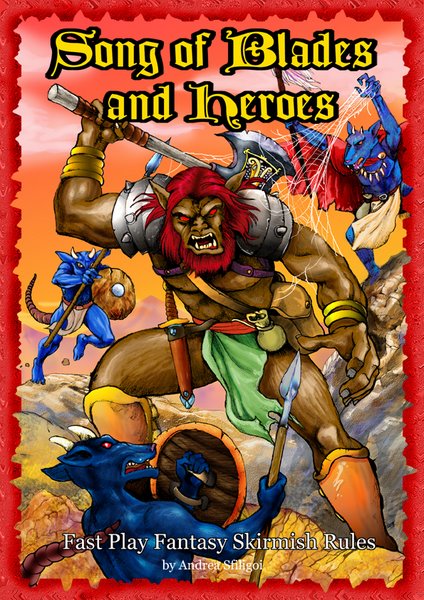
Why I like "A Song of Blades and Heroes"


Hey Paisanos, Time to try and make a one article a week quota to build some tolerance for the craft. This time I explore the skirmish wargame A song of Blades and Heroes (SBH) by Ganesha Games. So what brings my attention to making this a front-burner project?

1. Rules-light, tactics deep

Weighing in at 35 pages and costing $4, SBH is relatively easy to learn, with 3 stats per model and a handful of exceptions based special rules. a standard 300 point game runs for about half an hour. The book even has rules of campaign games, allowing you to have a narrative driven "Mordheim" style series of 3 to 5 matches in an evening's time. Fast, Furious Fun.

2. Use whatever model you want

While the book is filled with pre-gen statlines for most generic fantasy creatures, there website also has a nice java points calculator for making units. You can use whatever models you have on you.

3. Light investment by miniature wargames standards

the standard warband is about 10-15 models, and even less if you're rocking an elite force. My planned undead warband will consist of 28mm models from Reaper minis will set me back about 50$, shipping and handling included. After that it's just a matter of painting and basing. It's even cheaper in 15mm (the scale the game was designed for, though it has conversion guidelines for 28's), with their being an official line from Splintered Light Minis.


A Lizard-folk warband made of old Lizardmen and D&D Kua-Toa

4. Groovy expansions, with more to come
The game now has expansion books for competetive dungeon crawls, wilderness scenarios, and grandiose hex-based territory campaigns. A plethora of options awaits!

Friday, February 12, 2010

Risen from the Ruins

It has been approximately four months since "Grognard.txt" was posted, marking, at least in the short term, the death of this blog, once lauded as the official Online voice of the Lets Play Games Society. The lack of relevent material to be found on this blog has me convinced that I need to step back and reevaluate why I started this blog, what benefits I hope we can derive from it, and how best to reinvigorate it in light of recent events.

The LPGS has existed in some form or another for almost four years, in which time members have come and gone, activities have fallen out of favour, new interpersonal conflicts have sprung up and new conventions of group social interaction have come to the fore. For most of this time, we did not need, nor did we wish for, any sort of centeralized authority. Indeed, the noation of a centeralized authority was completely contradictory to what the group then represented and what I hope it still does.
An attempt was made, little more than a year ago, to coordinate and schedule our activities, that is, to subordinate the collective to the will of a single leviathan who promised us paradise for the sweat of our brow. Not surprisingly, after much contention, this attempt fell flat. However, from its failure came the integration of the LPGS into cyberspace and the rise of multiple group oriented blogs.

Since using these blogs to facilitate coordination runs against the principles on which our union was founded, most of the articles submitted to the afforementioned blogs have either been of an editorial nature, or undiluted copy-pasta, both of which hold the potential to shatter the fragile peace we have all worked so hard to acheive.
Today, I propose something different. Today I offer up my recommendations for the continued prosperity of our glorious union.

1) The only dirty word is "I". This is not to say that individual members cannot pursue their own interests, but rather that no member should subordinate the rest of the group to these interests, irregardless of circumstance. E.G, If you would rather play video games than 40k or Dungeons and Dragons, by all means feel free to do so, but don't try to derail an otherwise popular activity in order that your aims might be fulfilled. We are willing to give your interests and prospective activities a fair shake, therefore it is only fair that you extend to us the same courtesy.

2)By the same token, do not be openly disdainful of an activity in progress, irregardless of whether you are participating in it or not. We do not need to hear about how YOU think the game should be played. Respect the dungeon master (Where applicable) and moreover, respect the other players. If you wish to offer your criticisms of the game or of other players, please at least wait until after the game to do so.

While these will certainly not serve all the problems we are presently facing, it will ease tensions just enough to where we can solve our respective problems and come out of this stronger than ever before.

Thursday, December 10, 2009

Ironclaw Review


In the beginning there were the ancient Egyptians, who created their gods as anthropomorphic beings representing local creatures. Thousands of years later a group of funny animal enthusiasts from the sci-fi fandom would unite to split off into their own faction, know widely known as the furries. With their new identity they spread across the internet, bringing much wrath and bile against them.

At the same time as the birth of furries, several historical war gamers in Geneva, Wisconsin played a scenario where an elite team of fantasy heroes must infiltrate a castle through its dungeon. As time went on, they began to become attached to their characters, removing the pretense of tabletop war gaming to form a sort of improvised radio theater around their table, acting out their pewter miniature’s invented personalities and back stories. From this role-playing games (RPGs) were spawned, gaining popularity until and computer RPGs captured the mainstream, leaving old-style hobbyists to their pens and papers and needlessly complicated mathematic equations to determine the area of their wizard’s right foot.

Nerds, the furries and role-players eventually made contact over borders, and as a joint project created Ironclaw by Sanguine Productions.

FLUFF: Art and Fiction

We might as well start with the cover art, and instantly fall into our first warning sign of a possible lack of quality. It consists of two fox/wolf/wolverine/whatever females in poses signifying sorcery and lightheartedness. This is a problem for two reasons. The first is that as a piece it seems very amateur (this will be a repeating theme through most of the art and a point made later), not something you’d really want to use to attract a potential buyer, while telling us nothing thematic or descriptive about the game itself. I’ll bring about some examples. With White Wolf’s World of Darkness books, you instantly get a sense of what the game will provide. The core book is a shot of a mysterious man shambling down a gritty street, explaining that this will probably be a game of horror and mystery, their Vampire: The Requiem cover is a hand waving across falling petals, the entire hardback colored a blood-crimson: you know we’re dealing with blood and vampirism now. Even the old 3.5 Dungeons and Dragons books, while not having any illustrations of action or characters, looks like a dusty tome of something you’d see in a fantasy world. Not so with Ironclaw. While this may be a game of diplomacy and politics in a medieval isle, you’d know assume nothing about that aside from the arcana the two girls are weaving.

The second and far bigger problem is that this entire cover is a massive rip-off of Slayers: The Motion Picture, a decent fantasy anime, at least from the single first episode I once saw.

Ahhh, much better.

However the 2009 edition of the game has a cover is superior in every way, and might be indicative of the artwork inside, though I can’t say for sure myself.

As for the inside art, it’s a very, very mixed bag, and I mean that in the most critical way possible. It ranges from pretty good to absolutely atrocious, by far the worst offender being Brett Foster’s work in the Gifts and Flaws chapter. However, I give a thumbs up (except for the cover) to Tracy Butler’s comic on page 126 (It turns out that she is also the author of Lackadaisy Cats, and can actually draw humans well, so I have no complaints about her). The drawing of architecture are usually better then the art of characters themselves. Overall, while it does have its ups, for the most part the interior artwork is simply mediocre. Also, the style of the pictures themselves range from abstractly cartoonish to hyper-realistic to a balance in-between. In this way, Ironclaw does not have a thematic style or mood, no solid place on the grimdark/noblebright spectrum. It seems like they just got together, tossed it in a blender, and saw what they got (and I don’t mean that in a RIFTS way, we’re you toss in everything and the kitchen sink, and get the greatest campaign setting ever made).

It ranges from this...


...To this.

We now move on to the world and writing. Though you would think the results of the art would apply to the prose, it’s actually pretty decent. I mean it; it’s really not bad in comparison to the pencil and ink. Each chapter is ended or started with a one page vignette comics that are alright as long as you just stare at the speech bubbles and nothing else.

While I don’t have much to say about the setting, since aside from a lack of consistency, it’s hard to say whether a fantasy setting is good or bad. The game takes place in a fantasy world where animal species have evolved to become sentient and humanoid, forming the dominant races. More specifically, the target location is the island of Calabria. A long time ago, there were wizard kings called Autarchs that made cities out of gold, sank continents, raised mountains, kingdoms spread like jewels below a starry mantle, that sort of thing.

Long ago, before the oceans sank Atlantis and the rise of the sons of Aryas...

They then got bored and decided to blow up the earth (there are other theories, but they aren’t nearly as exciting). After the magic apocalypse, everyone decided to start an age of enlightenment. In the wake of this and the creation of gunpowder and science, noble houses started to come to the island Calabria to lay claim to natural resources which, like spice, must flow. Of course, there are also different religions like the Catholic Church proxy, and the remaining shamanic/pagan/hippy faiths that cling on. Gunpowder, cannons, and funny hats are catching on, phasing out armor and knights, so you probably won’t want to buy a crossbow unless you’re cheap or think it makes you a special. With powerful noble houses and flintlocks, it’s like a cross between A Game of Thrones and Warhammer Fantasy Roleplay, combining the diplomacy and intrigue of the former with the excitement of hoping your gun doesn’t blow up in your face and cause you to slowly die of black powder poisoning, or being stabbed with a rusty pitchfork and catching tetanus.

One minor complaint I might have though concerns the fact with such a huge amount of racial diversity, you’d think there’d be some heavy amounts of racism going on between, say, foxes and wolves. If you’re going to anthropomorphize something, you can’t just take the nice happy things about humans and discard the rest. Chimpanzees are vicious cannibals that rip off people’s faces, and dolphins form gang-rape squads against other dolphins. I also give a final argument against Ironclaw’s continued use of the old Aesopian stereotypes. Foxes are charismatic and good with women; bats live in gothic castles atop Carpathian-ish mountains and may or may not drink blood. Isn’t it time we dispersed of the old myths and had a fox that was a creepy fat stalker, or a raccoon that doesn’t suffer from kleptomania?

CRUNCH: Rules and Rolls

Oh boy, the best part of a role-playing game: numbers!

To create your character, you have a set amount of “points” that you can use to spend on your character’s skills and knacks, starting with his or her species. To balance out the fact that not everybody is equal in the furry kingdom, as a rhino in full plate armor is probably going to win against a coyote, more powerful species cost more points to play as, meaning you get fewer points to spend on other aspects of your character. The amount of different creatures to play as is large, though some consolidating has to be done. Lions and tigers are placed under “big cats”, the same with canines. Of course, you could play an ape, but that’s just a shitty version of a human.


You will soon learn to hate their kind.

Bizarrely, shrews and skunks are quite powerful, though maybe the skunks have evolved so their spray is nerve gas, I’m not too sure. Beyond races you buy skills and gifts (feats) for your brave adventurer. Give’im a name, spend some starting coin on your swords and shooters, and prepare to enter a realm of damsels and- hold on, let’s talk about task resolution.

What separates RPGs from a bunch of nerds having story time and interrupting each other to change the way the plot goes (though this is role-playing at its purist) is some sort of task resolution. The first and simplest type was determining if your knight could hit that annoying, fast-moving goblin on the second floor of the dungeon, though this was expanded to include characters attempting to perform difficult actions under duress or with long-lasting consequences for failure. This is the very reason why we have character sheets and dice, why it matters whether your character was specialized in lock-picking or history. It acts as a way to remove situations where two players start arguing whether Vlag the vampire is dead or not after being stabbed with a stake, or if Jim the mountain climber could make that 10 foot horizontal jump across that rocky gap in front of him.

In most RPGs, you try to succeed at something by rolling one or more dice and trying to hit a target number, or add up a number of successful die rolls out of a pool of dice, these usually given situational modifiers, like not being trained in something, or not having the right equipment for the job, or simply doing something really difficult. In Ironclaw, the better trained you are at something the more dice you roll for something, and the bigger those dice are. A novice at something would roll a d6, though someone more skilled might get a d12 and a d8, rolling and adding those together. Instead of trying get higher or lower than a set target number, the Game Master picks up some dice, more if the character is trying something tough, and rolls off, trying to get a higher number than the character. Beat the GM, you get lucky, otherwise you fail. While this certainly is an interesting way handle conflict, it doesn’t seem any more intuitive than rolling a straight d20, or rolling a percentile dice and hoping for a low number, or trying to beat a 4 on a type of die.

But what would a game about fantasy adventure be without exciting, violent combat? Ironclaw certainly has that, but maybe not the exciting part. I’m usually the most hesitant to look through combat rules since this is usually the most detailed, complex and simulationist part of a rule set. It seems to run a lot like the standard d20 combat, divided into rounds and turns. That said, there it is a little too crunchy for my tastes, and when I see that many charts, I tend to close the book and veer away. There is a bit more focus on the type of weapon a character wields, usually having some sort of modifiers to initiative or how precisely you can wield it, it’s all a bit much.

Your soul, is mine!

Finally is magic, wherein the weird and wonderful can occur. It runs on a power points system, in that you have a set amount of points or mana, and more powerful spells cost more to cast. Like combat, I don’t have much to say on this, it serves its part and if you could understand the combat system, you shouldn’t have a problem with this.

THE VERDICT


Occult power is grrrrrrrreat!

In conclusion, while Ironclaw tries hard to take a stab at being the definitive furry RPG, there is absolutely nothing special about it or inspires one to try and learn the rules of play, the artwork isn’t good, and the mechanics under the system are clunky. You could easily convert the species over to another, better known system like Savage Worlds or D20, and not lose too much in the translation. However, if you are dead-set on playing an anthropomorphic fantasy game, you might want to look into Shard, which, from their site and free PDF, has some quality art and skill behind it.

Friday, November 13, 2009

Games Workshop Doesn't Like Competition

PRESS RELEASE
GAMES WORKSHOP BRINGS COUNTERFEITER TO JUSTICE

NOTTINGHAM, UK (12 February 2007) - Games Workshop Group PLC, manufacturer of the famous Warhammer and Warhammer 40,000 wargames, has successfully brought a counterfeiter to justice.

Games Workshop dedicates considerable resources to protect its customers from deception and its business assets from infringement. Games Workshop recently concluded a lawsuit against Mr. Brian Beal, operating under the pseudonym ìMac Ace,î from selling forged figures through an ebay account.

After preliminarily enjoining Mr. Beal, ordering sanctions against him, and then issuing a permanent injunction, the United States District Court for the Western District of Missouri placed the finishing touch on this lawsuit by slapping Mr. Beal with an award of damages and attorneys fees. The award sends a strong message to those who, like Mr. Beal, believe duping consumers is an acceptable business practice.
ìIt is incredibly important to Games Workshop that the purity of the hobby and the quality of our products is preserved.î Said Andy Jones, Games Workshopís Head of Legal. ìWhen counterfeiters produce and sell fake miniatures, loyal hobbyists suffer. This decision vindicates our efforts to protect our intellectual property, preserve the hard-earned reputation of our product category-leading models, and safeguard the interests of our hobby and the fans who make it great.î

Games Workshop is a publicly traded company and the global market leader in tabletop hobby wargames

Thursday, October 29, 2009

Grognard.txt 3

It took me two days to learn D&D 3.5 from scratch, two goddam days, how much effort is that? About the same as watching a marathon of FRIENDS or scrubs followed by Lord of the Rings. It's not a big deal. 4th is like windows vista, you see some new things and elucidate "gosh, that makes so much sense, why ...didn't they do that earlier?", but on the vast majority of things I panic and scream "Oh god, they're ruining it!". You can bit-torrent all the 4th core books from Thepiratebay.com with utorrent.

It took me 30 minutes to learn Savage Worlds from scratch, 30 goddam minutes, how much effort is that? About the same as watching an episode of FRIENDS or scrubs followed by making a cup of noodles.


The system just seems to lock characters into roles. Magic users deal damage, fighters defend them, rogues deal damage and cause crazy effects. WTF? OK so now your sword becomes redundant, your mission in life is to tank like in WoW. Call me crazy, but I think that burning someone with a fireball is about as effective as stabbing them through the chest. And WOTC have the gall to call wizard robes "cloth armour" just to follow WoW. If you were wearing your casual clothes, I bet you'd get some funny looks if you started referring to it as armour.


How dare they attempt to make classes that don't cast magic useful?